Mitteleuropa Carnival: among masks, cowbells, and rituals
A journey among the Zvončari, Kurenti, and Rollate: the charm of ancient traditions
Every now and then I find myself coming across figures that stay with me.
Not because they are “beautiful” in the classical sense of the word, but because they carry something ancestral, almost magnetic. Enormous men dressed in furs, masks that erase the face, bells that make a noise impossible to ignore. The first time you see them, you don’t know whether you should smile, run away, or stand still and watch.
And this brings me to a confession: modern Carnival, unfortunately, doesn’t excite me.
I often see it reduced to an excuse to overdo things—a collection of low-cost costumes, assemblages of synthetic items bought online, where everything seems to scream “cheap” rather than care for detail. I feel that the sense of craftsmanship is often lost: sewing, fabrics, the stories behind the garments, the beauty of tradition that should emerge from every mask or costume.
That’s why, for me, the most beautiful Carnival is the one rooted in tradition, in stories, in the red threads that tie one generation to the next. The kind where every costume has a history, every garment is handed down, every mask tells the story of the land and the people who create it.
And this is where the thread that fascinated me comes into play: those figures that move across Mitteleuropa—from Italy to Slovenia, from Croatia to Austria—figures with very ancient origins that don’t seek spectacle for its own sake, but perform a ritual: breaking winter, driving away spirits, restoring fertility and life.
An encounter you don’t forget
Whether they are the Zvončari above Rijeka, the Kurenti of Ptuj, the Rollate of Sappada, the Austrian Perchten, or the Alpine Krampus, the effect is the same: they arrive making noise, they take up space, they disrupt order. And for a few hours, the world seems to turn according to different rules.
As a child (and even as an adult, I admit it), these figures terrified me. Not a “horror movie” kind of fear, but a subtler one: the fear of not understanding what you’re looking at. Man? Animal? Spirit? Tradition? All of it at once?
The red thread (or rather: the cowbell)
The thread that ties all these masks together is surprisingly simple: making noise to bring winter to an end.
Cowbells, shouting, jumping, erratic movements. In times when the rhythm of life was dictated by nature, winter wasn’t a poetic season—it was cold, stillness, hardship. Making noise meant “waking up” the earth, chasing away what had stagnated, setting the cycle back in motion.
It’s no coincidence that these masks appear between Epiphany and Carnival, never at Christmas. Christmas is home, silence, light. These figures are the opposite: chaos, excess, shadow.
Different masks, the same soul
Each territory has given a different shape to the same archetype.
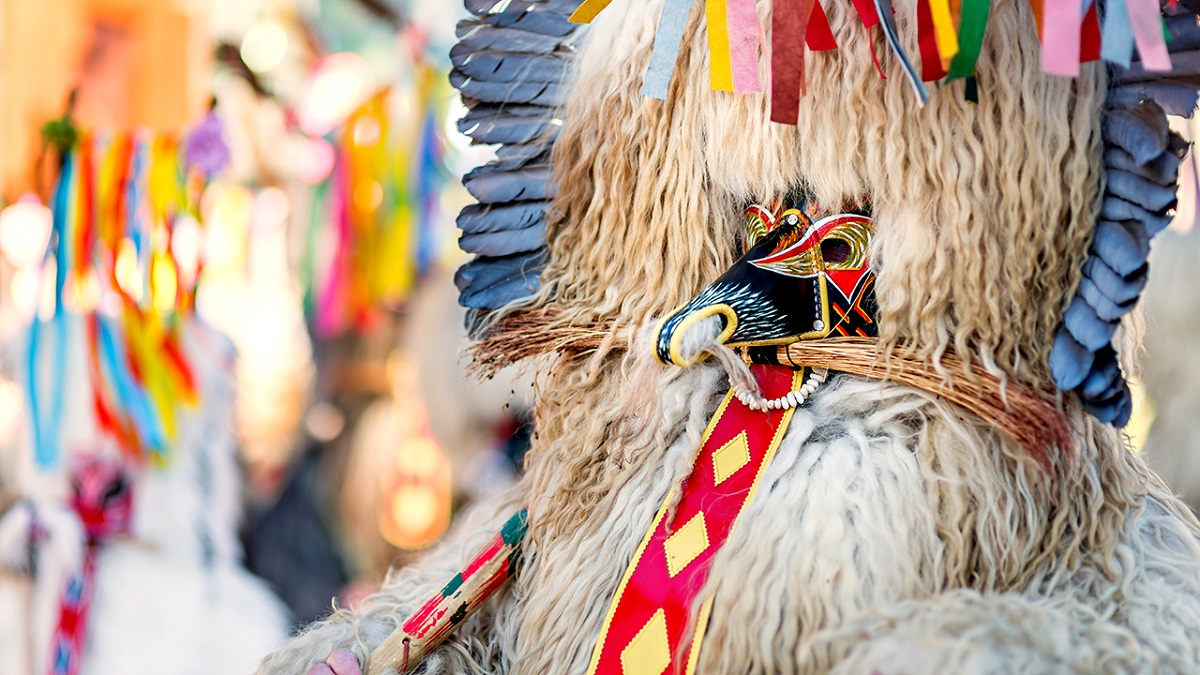
The Zvončari of the Kvarner wear furs and bells: they seem to walk with the sound of thunder.
The Slovenian Kurenti are more colorful and theatrical.
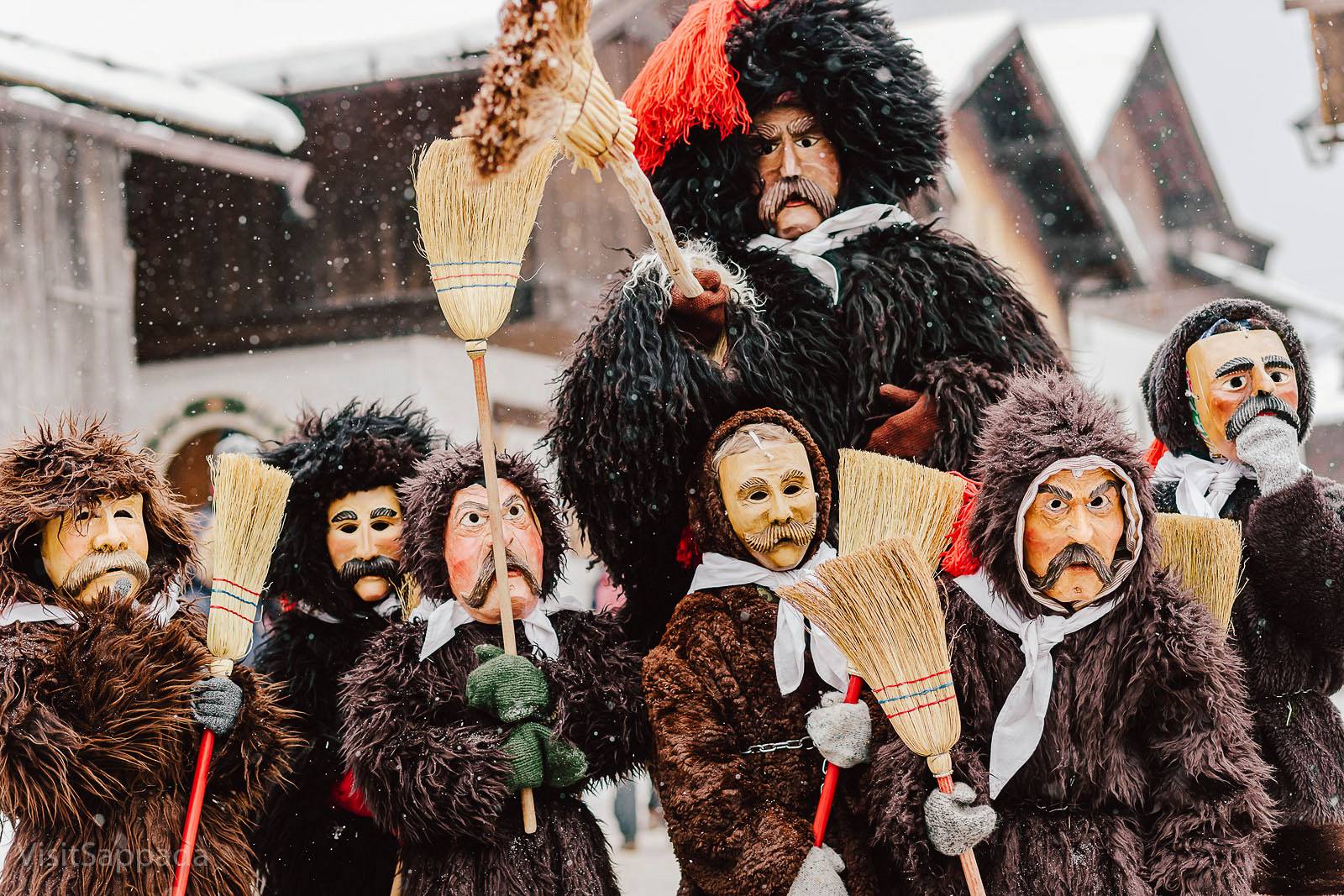
The Rollate of Sappada are grotesque and narrative, with wooden masks that look as if they’ve stepped out of a folk tale.
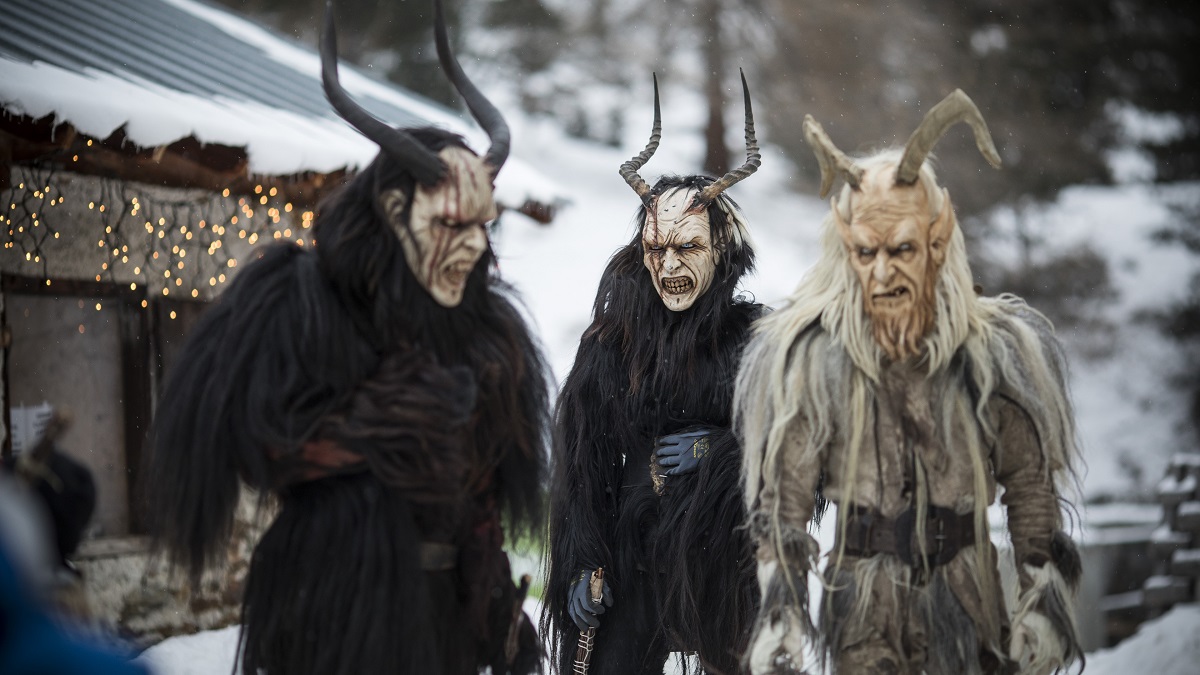
The Krampus are perhaps the most “domesticated” by Christianity, but beneath the horns and chains you can glimpse the same ancient spirit.
The materials change, the names change, but the function remains the same: breaking order so that it can be rebuilt.
Why they scare us (even though they shouldn’t)
There’s one thing that all the stories have in common: children were afraid.
And often adults were too.
Not because anyone wanted to educate through terror, but because these figures represent something we have almost forgotten today: the wild. The idea that there are forces we do not control, that are neither good nor evil, but necessary.
In many cultures, encountering these masks was seen as a kind of passage: facing chaos in order to return to normality.
An anecdote that always makes me smile
At the end of the procession, something curious happens: the masks come off.
And underneath is the neighbor, the bartender, the family friend. And that’s when everything melts away.
That gigantic, noisy figure suddenly becomes human again. And it almost feels funny to have been afraid of it.
Why talk about this today
We live in a time that loves order, control, perfect aesthetics.
These masks are the exact opposite: uncomfortable, noisy, imperfect.
And yet they keep coming back, every year, to the same places. As if to remind us that we need this too: a moment when everything is too loud, so that we can then begin again.
And deep down, in this Carnival, a bit of history, tradition, and authenticity is far more fascinating than any costume bought online.
For me, this is the true Carnival: the one of masks passed down from generation to generation, of stories that span centuries, and of red threads connecting the past to the present.
This website uses cookies so that we can provide you with the best user experience possible. Cookie information is stored in your browser and performs functions such as recognising you when you return to our website and helping our team to understand which sections of the website you find most interesting and useful.
Strictly Necessary Cookies
Strictly Necessary Cookie should be enabled at all times so that we can save your preferences for cookie settings.
If you disable this cookie, we will not be able to save your preferences. This means that every time you visit this website you will need to enable or disable cookies again.
3rd Party Cookies
This website uses Google Analytics to collect anonymous information such as the number of visitors to the site, and the most popular pages.
Keeping this cookie enabled helps us to improve our website.
Please enable Strictly Necessary Cookies first so that we can save your preferences!
Additional Cookies
This website uses the following additional cookies:
(List the cookies that you are using on the website here.)
Please enable Strictly Necessary Cookies first so that we can save your preferences!